
How F1 Safety Cars Change Everything
Virtual Safety Cars, full Safety Cars, and red flags — how race interruptions reshape strategy, erase gaps, and create prediction chaos. With real data from Australia's 4-VSC opening round.
You've done everything right. Checked the long-run data, factored in tyre degradation, mapped team strengths to circuit demands. Your prediction is airtight. Then a car parks itself in a barrier on lap 22, the safety car rolls out, and your carefully constructed finishing order gets thrown in a blender.
Sound familiar? Safety cars are the great disruptor of F1 predictions. They erase gaps, hand out free pit stops, compress the field, and turn a procession into a sprint. You can't predict when they'll happen. But you can predict how likely they are, understand what they do to strategy, and build that into your picks at circuits where chaos is practically guaranteed.
The Three Types of Race Interruption
F1 has three mechanisms for managing on-track incidents, and each one hits strategy and the competitive order in dramatically different ways.
Full Safety Car (SC)
This is the big one. A physical safety car leads the field around the track at roughly 40% of racing speed. All cars form a queue behind it.
What happens:
- All gaps vanish. A 30-second lead becomes zero. Twenty laps of hard-earned advantage, gone in moments.
- Lapped cars may unlap themselves. Backmarkers are allowed to pass the safety car to clear the way for a clean restart.
- Pit stops become nearly free. At racing speed, a pit stop costs around 22-25 seconds. Under the safety car, the field is crawling, so pitting costs only 10-12 seconds.
- Restarts breed chaos. The leader controls the restart pace, creating a concertina effect that catches midfield drivers off guard.
Virtual Safety Car (VSC)
A lighter touch. Drivers must maintain a delta time, driving approximately 30% slower than normal (around 70% pace). No physical safety car, no queue.
What happens:
- Gaps are roughly maintained. Unlike a full SC, the VSC theoretically preserves the gaps between cars (though in practice, faster cars on the in-lap/out-lap can sneak small advantages).
- Pit stops are still cheaper, about 10-15 seconds less than a normal stop, depending on pit lane length and VSC duration.
- No restart drama. The VSC ends and racing resumes at the VSC line. Less chaos, less opportunity for upset.
- Shorter deployment. VSCs are typically resolved faster than full safety cars, making them less strategically disruptive.
Red Flag
The nuclear option. The race stops. All cars return to the pit lane, engines off.
What happens:
- Free tyre change for everyone. Cars can fit any compound and make repairs during the stoppage.
- All gaps reset to zero. The race restarts from a standing or rolling start with the field in order but with no time gaps.
- Strategy gets thrown out entirely. Whatever plan a team had is dead. Everyone starts fresh with new tyres and a shorter remaining distance.
Comparison
| Factor | Full SC | VSC | Red Flag |
|---|---|---|---|
| Gaps erased? | Yes — completely | No — roughly maintained | Yes — completely |
| Free pit stop? | Nearly free (~12s cost) | Cheaper (~15-18s cost) | Completely free |
| Lapped cars unlap? | Yes (usually) | No | Positions reset to order |
| Restart type | Rolling behind SC | Crosses VSC line | Standing or rolling |
| Duration | 3-6 laps typically | 1-3 laps typically | 10+ minutes |
| Chaos level | High | Medium | Maximum |
How Safety Cars Change Strategy
The "Free" Pit Stop
This is the single most important strategic concept to understand. Here's the math:
Normal pit stop cost: ~22-25 seconds (time lost vs. staying on track)
Safety car pit stop cost: ~10-12 seconds (field is going slowly, so less time lost)
Net saving: 10-15 seconds. Essentially half a pit stop for free.
Why does that matter so much? Because it completely changes the strategic calculus:
- A team that was marginal on a 1-stop strategy (tyres barely lasting) suddenly gets a free switch to fresh rubber with minimal cost
- A team already committed to a 2-stop gets one stop nearly free, gaining time on the 1-stoppers
- A team that hasn't pitted yet gets to pit "for free" while leaders who already stopped gain nothing
Who Benefits and Who Loses
| Position | Impact |
|---|---|
| Leader with a big gap | Loses the most. Their built advantage just evaporated. |
| Car just about to pit | Benefits enormously. Gets a near-free stop at the perfect time. |
| Car that just pitted | Neutral. Already on fresh tyres, maintains position. |
| Car on alternate strategy | Massive benefit. The free stop validates an aggressive strategy that wouldn't have worked otherwise. |
| Backmarkers (lapped) | Huge benefit under full SC. They can unlap themselves and rejoin the lead lap. |
Case Study: Australia 2026 and Its Four VSCs
The opening round of 2026 at Albert Park was a masterclass in how race interruptions reshape the competitive order. Four VSC periods in 58 laps turned what should have been a straightforward Mercedes cruise into a strategic chess match.
The VSC Timeline
| VSC | Laps | Cause | Strategic Impact |
|---|---|---|---|
| 1 | 11–14 | Hadjar PU failure from P3 | Mercedes + Norris pit during VSC — near-free stops. Ferrari stays out. |
| 2 | 16–20 | Bottas retirement | Gap compression benefits Verstappen's recovery from P20 |
| 3 | 22 | Brief (Alonso incident) | Minimal strategic impact — most teams had already committed |
| 4 | 32–34 | Late-race debris | Compressed gaps again, gave trailing cars a chance to close up |
How the VSCs Shaped the Race
The race stint data for the top 6 finishers tells the story. You can see the VSC periods as pace disturbances in the lap times:
Australia 2026 — Race Stint Data (Top 6 Finishers)
What the VSCs actually did to the race:
-
Mercedes won the strategy lottery. Russell and Antonelli pitted under VSC 1 (lap 12), converting what would have been a 22-second pit stop cost into roughly 10 seconds. That "free" stop locked in their 1-2 finish.
-
Ferrari went long to compensate. Unable to pit under the same VSC without losing track position, Leclerc stayed out until lap 25 and Hamilton until lap 28. Their longer medium stints put them on fresher hards for the closing phase, offsetting the Mercedes VSC advantage with pure tyre life.
-
Verstappen's P20 to P6 recovery was VSC-enabled. Four gap compressions over 58 laps gave Verstappen repeated opportunities to close on and pass cars ahead. Without the VSCs, his recovery probably stalls around P8-P10. The VSC periods, combined with his fastest-lap pace (1:22.091), turned a damage-limitation exercise into a strong points haul.
Safety Car Probability by Circuit Type
Not every circuit is equally likely to produce a safety car. Track design (narrow or wide, barriers or runoff, street or permanent) determines how often incidents require intervention.

Circuit Profile
Marina Bay Street Circuit
Singapore
Circuit Demands
Singapore is basically safety car guaranteed. Narrow street circuit with concrete walls, 19 corners, a bumpy surface that punishes every mistake, and humidity-induced fatigue that makes errors more likely as the race wears on. Any mistake here puts a car in the wall, and a car in the wall triggers a safety car. The SC/VSC rate at Marina Bay is among the highest on the calendar.
Circuit Profile
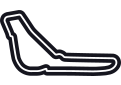
Autodromo Nazionale Monza
Monza, Italy
Circuit Demands
Monza is the opposite. Wide-open layout with expansive gravel traps and paved runoff. Mistakes rarely leave a car stranded. Drivers can rejoin from most off-track excursions without trouble. The heavy braking zones at chicanes do produce occasional incidents, but the overtaking difficulty is only 3.0, meaning cars spread out rather than bunch up in dangerous proximity.
General Rules
| Circuit Type | SC/VSC Probability | Why |
|---|---|---|
| Street circuits (Monaco, Singapore, Baku) | Very high | Walls punish every mistake; no recovery room |
| Tight permanent circuits (Melbourne, Hungaroring) | High | Narrow sections with barriers close to the track |
| Open permanent circuits (Silverstone, Spa, Monza) | Lower | Wide runoff areas absorb most incidents |
| Wet races (any circuit) | Very high | Reduced grip + spray = more incidents regardless of layout |
Factoring Safety Cars Into Predictions
You can't predict when a safety car will happen. But you can absolutely adjust your approach based on how likely one is.
At High-SC Circuits
- Compress your predicted gaps. Think the leader will win by 20 seconds? Predict 8 instead. Safety cars will erase gaps.
- Value reliability more. At chaotic circuits, simply finishing is valuable. Predict reliable teams higher and account for likely DNFs in the midfield.
- Weight raw pace over strategy. Clever strategy advantages get wiped out by safety cars. The fastest car on the restart is the one that benefits most.
- Predict aggressive starters higher. Drivers known for strong first laps (Leclerc, Hamilton) gain more at high-SC circuits because any advantage they grab at the start gets preserved by subsequent safety car periods.
At Low-SC Circuits
- Trust the strategy model. Without safety car disruptions, tyre strategy plays out as the data predicts. Long-run pace and degradation data from FP2 are highly predictive.
- Value pit stop efficiency. Without free safety car stops, every pit stop costs the full 22-25 seconds. Teams with fast pit crews gain a real advantage.
- Predict wider gaps. Without gap compression, the faster car pulls away. If practice data shows a 0.5s per lap advantage, predict a dominant win.
The Wildcard: First-Lap Incidents
Regardless of circuit safety car probability, the first lap is always the most dangerous. Cars bunched together, cold tyres, adrenaline. At the Australian GP, two cars were out before completing a single racing lap.
For predictions: P5-P15 grid slots carry the highest first-lap risk because that's where the field is most compressed. If you're unsure about a midfield prediction, consider the possibility that one or two cars in that range won't survive the opening corner, and the drivers behind them will shuffle up.
Quick Reference
| If... | Then... |
|---|---|
| Circuit has narrow barriers and low overtaking | Expect 1-2 SC/VSC periods per race |
| Weather is changeable (rain possible) | Increase chaos probability significantly |
| A team is near their pit window at typical SC laps | They may benefit from timing luck |
| The field is close in qualifying (top 10 within 0.5s) | First-lap incidents more likely — compressed field |
| A driver is starting from the back with a fast car | Safety cars help recovery drives enormously |
| The circuit has a high-speed Turn 1 | First-lap incidents are less likely than at slow Turn 1s |
Safety cars are the one thing that separates F1 predictions from pure data analysis. You can model pace, degradation, and strategy perfectly and still get undone by a random incident on lap 30. The best response isn't to ignore that reality. It's to build it into your predictions: be more conservative at chaotic circuits, trust the data more at clean ones, and always leave room for the unexpected.
For more on race strategy and how safety cars interact with pit stop planning, check out A Beginner's Guide to F1 Tyre Strategy. Ready to test your predictions at the next race? Join Podium Prophets.